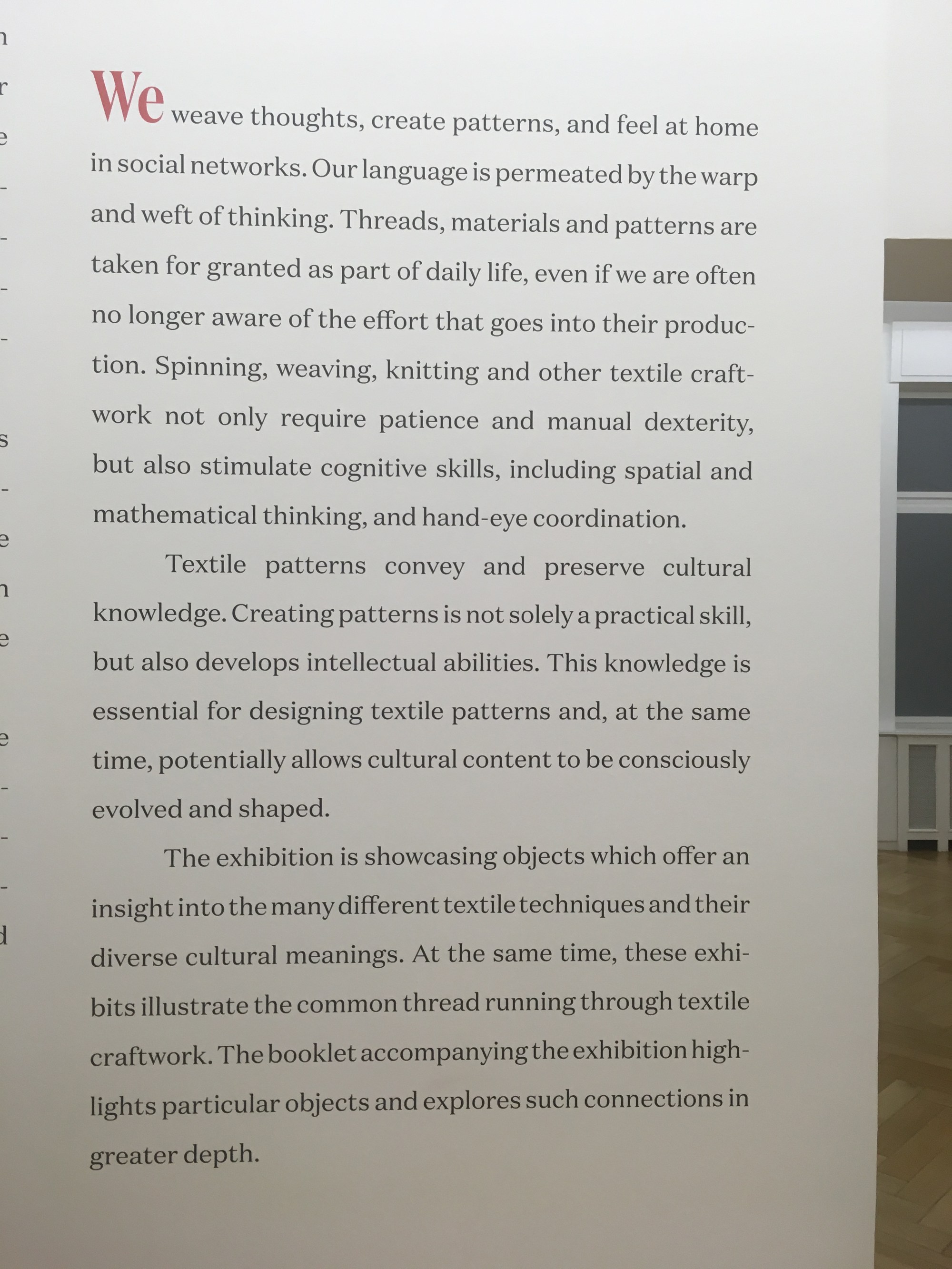
Hallo all!!! Today we took a trip the museum of thread. The featured photo is the idea that the museum wants you to embody. This trip was very enlightening because there were was a wide variety of threads from cultures from all over the world. I was even taught how to thread. We used the “Rückenwebgerät” which translates to “Back web machine” or “Backstrap loom.” That means you are operating the thread machine with one end either hanging on a wall or from another person and the other side is a wrapped around your waist. When you move back then the machine would tighten up and if you moved forward to produced slack, then the machine would fall down towards the wall. (I’m trying my best to explain so bare with me.) Our lovely tour guide carefully helped us through this process. The picture with all the red symbols are many woven patterns on Tacana bags and their meanings. Tacanå is a town in the Guatemalan district of San Marcos. These patterns can be different animals or parts of animals, or even just complex shapes. They have Snake head, full snake body, dog tracks, people, etc. The Tacanå would use their machines and create these patterns within the thread. Sometimes containing abstract meanings, other times being a picture of someone or something. The bags hanging on the wall were traditionally women’s purses. My tour guide explained that men would not typically use them because the women used them for safe keeping of important but also easy to store items. Two pictures from the purse picture, there are Wax container and batik stamps. There were used in Java,Indonesia. These are batik Tulis, those “hand drawn” in a mix using a stylus called canting. The canting is like a little pen with a copper bowl containing liquid wax and with one or more spouts. To apply the mix successfully to the fabric, the composition of the mix and its temperature are crucial. Initially, Batik Tulis was exclusively made by women, but since these copper stamps were very heavy, men now started working in batik production as well. Two pictures to the right, these are trade baskets in Chitimacha, Lousiana. These were acquired by the museum at the beginning of the 20th century, these baskets epitomizes the struggle of the Chitimacha people to hold onto their identity in the face of cultural loss. Sarah Senses is a basket artist. She is able to put pictures of people within the thread of the baskets. This absolutely blew my mind. Sarah was an absolute genius. This museum has some mind blowing ideas. The picture in the fifth row on the right is supposed to symbolize the “thread of life.” They placed items/tools on the threads. In that same room, on the wall, there were numbers and letters. On the 6th row, the picture on the left shows how mathematics is a big part of threading. There was a scientist who found this formula (X’n X= C’x.) This was very confusing to me seeing as math is not my forte. But still it was very eye opening to find out even when making a pair of pants, there is always some degree of math involved. On the sixth row, second from the left, there is the portable spinning wheel. In India, they made this from wood and metal and used raw cotton, cotton thread. This even used by the world renown Mahatma Ghandi. Ghandi had a vision of a self reliant India. The spinning was a symbol of economic independence from British Colonial power. It’s amazing what one piece of thread and what one idea can do for a nation. Every nation has something to offer the world. We are all different, but differences are what makes the world so beautiful and so special. If everyone acted the same, or looked the same, then the world be a pretty boring place. I know I would get tired of seeing my own face. Eventually 😉 After a couple hundred years. Alright folks, that’s all for today’s history lesson. I hope you have learned something new and maybe become inspired to start your own thread. Talk to you all soon. Stay Tuned!!!


 Auslander